THREE GENERATIONS OF LEARNING: THE GHOLAM MUSTAFA–MUJTABA FAMILY LEGACY
My father, Gholam Mustafa — My Teacher, My Guide, and My first hero.
From Calcutta’s academic tradition to leading universities in Britain and America, six children carry forward a family commitment to education, professional achievement, and service
By Dr. Gholam Mujtaba, M.Sc.,
M.D., Ed.D., FRSPH, FICPS
There are inheritances measured in property and wealth, and there are inheritances that cannot be measured on a balance sheet. My father, the late Gholam Mustafa, left our family an inheritance of education, integrity, discipline, faith, and public service. Today, I see that inheritance continuing through my six children—four sons and two daughters—whose educational journeys have taken them through distinguished universities in the United States and the United Kingdom.
Gholam Mustafa: Where the Legacy Began
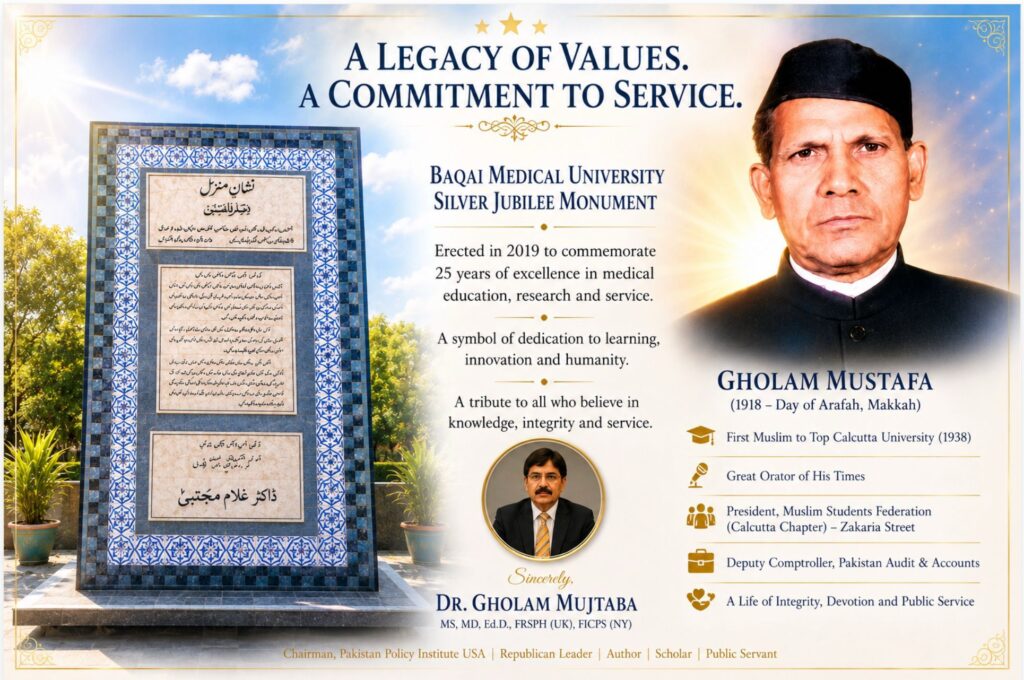
Born in 1918 in Mir Ghias Chak, Bihar Sharif, my father belonged to a generation that came of age during the final decades of British India. According to our family record, in 1938 he became the first Muslim to top Calcutta University, then one of the Indian subcontinent’s foremost universities, situated in the great intellectual and political center of Calcutta.
But his distinction was not confined to examinations. Gholam Mustafa was also remembered as an accomplished orator of his generation and served as President of the Muslim Students Federation’s Calcutta chapter at Zakaria Street. His student leadership reflected the political awakening and intellectual ferment among Muslim students in pre-Partition India.
He subsequently migrated to Lahore before independence and devoted his professional career to Pakistan, ultimately serving as Deputy Comptroller in Pakistan Audit & Accounts. Education, honesty, faith, and public responsibility remained the foundations of his life.
His final chapter was profoundly symbolic for our family. He passed away on the Day of Arafah while performing his second Hajj and was laid to rest in Jannat-ul-Ma’ala, Makkah.
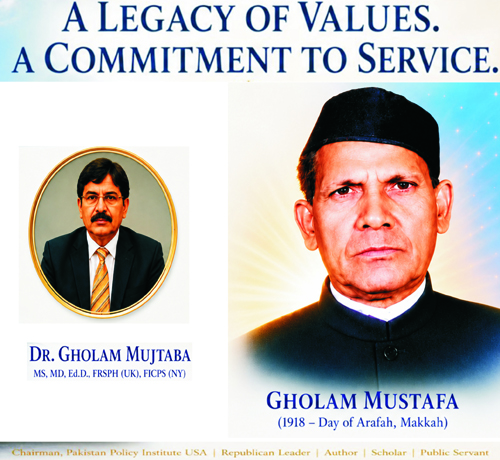
The accompanying tribute to him describes him in the simplest and perhaps most meaningful words:
“A Father, A Teacher, A Guide — My First Hero.”
The Second Generation: Carrying My Father’s Educational Mission
As his son, I sought to carry that commitment into my own academic and professional life.
My educational journey began with pharmacy at the University of Karachi, followed by postgraduate studies in London, including an M.Sc., a medical degree (M.D.), and later a Doctor of Education (Ed.D.). My academic and professional credentials have also included FRSPH and FICPS.
My career crossed the boundaries of healthcare, pharmacology, education, public affairs and public service. I taught pharmacology at the University of Karachi, served in public life, and continued my involvement in education and policy in the United States.
Yet among the achievements that give me the greatest satisfaction is seeing the educational principle my father taught pass intact into a third generation.
Six Children — Four Sons and Two Daughters — Carry the Legacy Forward
My six children have pursued careers in medicine, nursing and advanced clinical practice, radiology, healthcare administration, business, real estate, and other professional disciplines. Collectively, their educational paths have been associated with institutions including King’s College London, the University of Edinburgh, Duke University, New York University, Columbia University, Pace University, the University of Chicago, Georgia State University, and other universities and professional institutions.
Dr. Athar Mujtaba has extensive multidisciplinary education spanning medicine, advanced nursing practice, healthcare, and business. His credentials include an M.D., DNP-FNP, M.S., and M.B.A., with advanced postgraduate studies at institutions including Pace University, the University of Edinburgh, and Duke University. His professional work has combined clinical practice with the education and supervision of future healthcare professionals.
Dr. Assad Mujtaba likewise represents the family’s combination of medicine, healthcare leadership, and advanced clinical education. His academic credentials include an M.D., DNP, M.S., and M.B.A., with his Doctor of Nursing Practice earned at New York University and additional postgraduate education at the University of Edinburgh. His career has spanned emergency and family healthcare, education, healthcare administration, and community service.
Dr. Tarannum Mujtaba, M.D., M.B.A., pursued one of medicine’s demanding specialist pathways. After completing medical education and postgraduate training, she entered diagnostic radiology and subsequently completed advanced fellowship training, including neuroradiology at the University of Chicago and specialized training in breast imaging. Her educational journey reflects years of focused preparation for medical residency and fellowship.
Dr. Ayesha Mujtaba pursued an interdisciplinary career in healthcare and academia, with education spanning medicine, advanced nursing, and business. Her credentials include M.D., M.S., M.B.A., and FNP-BC, and her professional experience extends into healthcare education and academic leadership.
Ahsan Mujtaba, educated at Georgia State University, earned A.S. and B.S. degrees and entered the business and commercial real estate field, adding a different professional dimension to a family heavily represented in healthcare and academia.
Hyder Mujtaba has pursued a progression through B.S., M.S., and M.S.N.-R.N. education, including study at Columbia University, an Ivy League institution. His path represents another extension of the family’s commitment to advanced healthcare education.
From One Student in Calcutta to an Internationally Educated Family
What makes this story meaningful to me is not any single degree or university name. It is the continuity.
A young Muslim student named Gholam Mustafa distinguished himself academically in Calcutta in the 1930s. He taught his children that knowledge was an asset no political upheaval, migration, or economic circumstance could take away.
His son continued that journey through pharmacy, medicine, postgraduate education, and teaching.
And today, his six grandchildren—four grandsons and two granddaughters—have carried that educational tradition across generations and across continents, studying and training at institutions in Britain and the United States.
From Calcutta to Karachi, London, Edinburgh, Durham, New York, Chicago and Atlanta, the geography changed. The principle did not.
The presence within one immediate family of numerous undergraduate, graduate, medical, doctoral and professional qualifications is an achievement worthy of celebration—not merely because of the number of degrees, but because it demonstrates what can happen when education becomes a multigenerational family culture rather than an individual accomplishment.
Universities such as King’s College London, Edinburgh, Duke, NYU, Columbia, Pace, the University of Chicago, and Georgia State represent very different academic traditions. Yet across these institutions, another generation of our family has pursued the same ideal that Gholam Mustafa embraced nearly nine decades ago: learn, achieve, serve, and leave the next generation better prepared than the one before it.
The Greatest Inheritance
My father’s wealth was never measured by what he left in a bank.
It is measured by the education of his children and grandchildren, by the professionals they became, by the patients they serve, by the students they teach, and by the opportunities they create for the generation that follows them.
Gholam Mustafa’s greatest monument is therefore not made of stone. It is a living educational legacy.
As his son, and as the father of six children who have carried that tradition forward, I regard this collective educational achievement as one of our family’s greatest blessings.
Three generations. Numerous advanced and doctoral qualifications. Some of the world’s distinguished universities. One continuing principle: education, integrity, and service.
And for all that followed, the first acknowledgment belongs to the man with whom it began: