From Mediator to Strategic Ally? The Iran–Pakistan–U.S. Triangle and Pakistan’s Inevitable Tilt Toward Saudi Arabia
As the Iran conflict widens, Pakistan may face an unavoidable strategic choice: maintain peaceful relations with Tehran while standing firmly with Saudi Arabia, the GCC, and the United States to defend regional security.
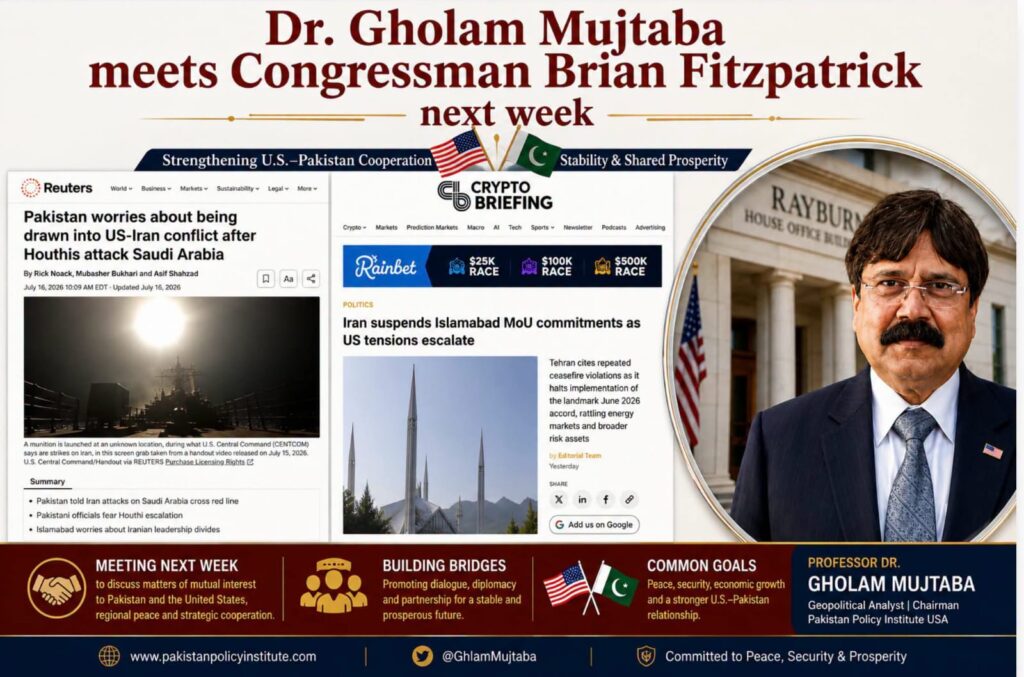
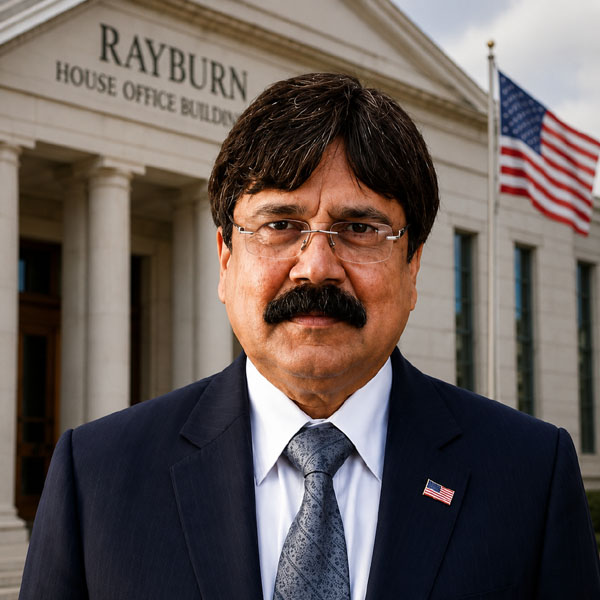
By Professor Dr. Gholam Mujtaba
Geopolitical Analyst and Chairman, Pakistan Policy Institute USA
The escalating conflict in Iran is rapidly reshaping the strategic landscape of the Middle East and South Asia. Perhaps no country faces a more consequential choice than Pakistan.
Islamabad initially sought to position itself as a diplomatic bridge between Washington and Tehran. That role remains valuable, but emerging strategic realities suggest that Pakistan cannot indefinitely remain equidistant between Iran on one side and the United States, Saudi Arabia, and the Gulf Cooperation Council states on the other.
Pakistan shares a border with Iran, and peaceful relations with Tehran remain essential. But Pakistan’s broader national interests—its defense partnerships, economic needs, overseas workforce and longstanding relationship with Washington—arguably place its strategic center of gravity closer to Saudi Arabia, the GCC and the United States.
The question, therefore, is no longer simply whether Pakistan can mediate the Iran conflict. It is whether continued escalation could compel Islamabad to move decisively from mediator to strategic ally.
Saudi Arabia: A Relationship Pakistan Cannot Abandon
Pakistan’s relationship with Saudi Arabia extends well beyond conventional diplomacy.
For decades, the Kingdom has remained one of Pakistan’s closest strategic and economic partners. Defense cooperation between the two countries has deep historical roots, and Saudi financial support, deposits, energy arrangements, and investment have repeatedly provided Pakistan with important economic assistance.
Equally important is the human relationship.
Millions of Pakistanis work throughout the Gulf, with Saudi Arabia being one of the largest destinations for Pakistani workers. Their remittances support millions of family members at home and contribute substantially to Pakistan’s foreign-exchange position.
For Islamabad, therefore, the stability of Saudi Arabia and the Gulf is not an abstract foreign policy consideration. It is directly tied to Pakistan’s economic and national security.
If Saudi territory, population centers, or strategic infrastructure were subjected to sustained attacks by the Houthis or other forces receiving material support from Iran, Pakistan could find it increasingly difficult to sustain neutrality.
Pakistan should continue to seek peaceful relations with Tehran. But there is an important distinction between maintaining good relations with a neighbor and remaining neutral when a treaty partner and longstanding ally is attacked.
In such circumstances, Pakistan’s strategic tilt toward Saudi Arabia would not necessarily signal hostility toward Iran; it would reflect the realities of Pakistan’s national interests and defense obligations.
The United States Factor
The United States is the other critical component of this strategic equation.
Despite periodic tensions, Pakistan and the United States have maintained one of South Asia’s most consequential relationships for decades. Their cooperation has spanned defense, counterterrorism, intelligence, regional stability, and economic engagement.
Pakistan has every reason to strengthen its relationship.
A stable partnership with Washington can provide Islamabad with diplomatic influence, access to international economic institutions, security cooperation, and greater strategic relevance at a time when the global order is increasingly polarized.
This does not require Pakistan to participate in an offensive war against Iran.
Rather, Islamabad can pursue a policy of strategic alignment without abandoning diplomatic engagement: maintaining communication with Tehran while cooperating with Washington, Riyadh, and the GCC to protect regional stability, international shipping, energy infrastructure, and allied territory.
Iran, in turn, must recognize that continued IRGC support for regional proxy forces carries consequences beyond the immediate battlefield. If Iranian-backed forces threaten Saudi Arabia or destabilize vital maritime corridors, countries that might otherwise prefer neutrality could be gradually pushed toward the opposing security coalition.
Pakistan could be among them.
The Baluchistan Danger
The most serious risk to Pakistan lies along its western frontier.
Pakistan and Iran share a sensitive border through Baluchistan, where militancy, separatist organizations, smuggling networks, and cross-border armed groups already create a difficult security environment.
A Houthi ground operation against Saudi Arabia would not, geographically, amount to an invasion of Pakistani Baluchistan. However, a broader Iran-Saudi confrontation, with Pakistani military support for Riyadh, could have indirect consequences along the Iran-Pakistan frontier.
The potential escalation pathway is concerning:
Houthi attacks on Saudi Arabia → Saudi military response → activation of Pakistan’s defense commitments → Iranian pressure on Pakistan → increased proxy or militant activity → instability along Baluchistan → potential Iran-Pakistan military confrontation.
This remains a speculative scenario rather than a prediction. Nevertheless, the presence of Pakistani military personnel and air assets in Saudi Arabia makes the possibility of unintended escalation worthy of serious consideration.
If Pakistani forces defending Saudi territory were attacked by Iranian or Iranian-backed forces, Islamabad would face immense domestic and strategic pressure to respond.
At that point, Pakistan’s role as a mediator could become increasingly difficult to maintain.
Pakistan Must Make Its Red Lines Clear
Pakistan’s best strategy is therefore not ambiguous neutrality but clearly defined strategic diplomacy.
Islamabad should communicate directly with Tehran that Pakistan seeks peaceful, mutually respectful relations with Iran. At the same time, Tehran should understand that Pakistan cannot remain indifferent to sustained attacks on Saudi Arabia or other GCC partners, particularly when Pakistani forces and millions of Pakistani nationals may be directly affected.
Pakistan should also deepen consultations with Washington and Riyadh while emphasizing that its military commitments are fundamentally defensive.
The message should be straightforward:
Pakistan does not seek war with Iran. Pakistan will continue to support diplomacy with Iran. But Pakistan will also defend its vital national interests and honor its legitimate security commitments to its allies.
Such clarity may reduce the risk of miscalculation.
A Strategic Choice That May Already Be Taking Shape
A deliberate Iran-Pakistan war remains unlikely and would be disastrous for both countries. Pakistan has no interest in opening another front, and Iran has little strategic incentive to confront a nuclear-armed neighbor while already under enormous external pressure.
Nevertheless, wars often arise not from deliberate decisions but from a chain of alliances, proxy actions, and retaliatory commitments.
Pakistan therefore stands at a historic crossroads.
Geography requires Islamabad to maintain peaceful relations with Tehran. However, Pakistan’s economic interests, defense relationships, Gulf workforce, and broader international orientation increasingly connect it to Saudi Arabia, the GCC, and the United States.
If forced to choose between neutrality and defending Saudi Arabia against sustained external aggression, Pakistan’s strategic, economic, and security calculations are likely to produce a Saudi tilt.
That should surprise no one.
The challenge for Islamabad is to make that alignment a deterrent rather than a pathway to war. Pakistan should stand firmly behind the territorial security of Saudi Arabia and its Gulf partners while keeping diplomatic channels open to Tehran.
Pakistan’s objective should be peace with Iran—but not at the expense of its strategic partnership with Saudi Arabia, the security of the Gulf, or its long-term relationship with the United States.
The coming months may determine whether Pakistan can maintain this delicate balance. If escalation continues, Islamabad may find that the era of strategic ambiguity is ending.
Pakistan can remain a bridge to Iran while standing with its allies. But if the bridge collapses, the realities of national interest suggest that Islamabad’s strategic weight will increasingly shift toward Riyadh, the GCC, and Washington.
— Professor Dr. Gholam Mujtaba
This article presents geopolitical analysis and forward-looking scenarios. Potential future military developments discussed herein are speculative and should not be construed as predictions or established intelligence.