

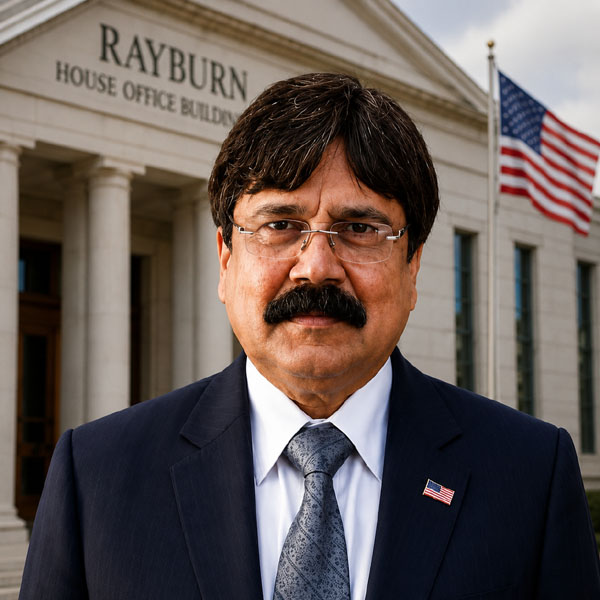
WHEN EDUCATION LEADS, NATIONS RISE — WHEN IGNORANCE RULES, DEMOCRACIES DECLINE
Why Academic Excellence, Intellectual Integrity, and Professional Competence Matter in Political Leadership
By Prof. Dr. Gholam Mujtaba, Ed.D., MD.
Scholar of Education & Medicine
Democracy Must Reward Competence, Not Merely Popularity
Democracy is one of humanity’s greatest political achievements. It gives ordinary citizens the extraordinary power to determine who governs them. Yet democracy carries an inherent responsibility: the obligation to distinguish between those who merely seek power and those who possess the intellectual capacity, professional discipline, and moral judgment to exercise it wisely.
A political candidate may attract thousands through slogans, emotional appeals, personal popularity, or financial influence. But governing a city, a state, or a nation demands something far more substantial.
Winning an election requires votes. Governing successfully requires knowledge, judgment, competence, and character.
The question facing modern democracies is no longer simply who can win an election. It is who possesses the preparation, experience, and intellectual maturity to justify the public trust.
Education Is Not a Decoration — It Is Preparation for Responsibility
As a scholar of education and medicine, I have spent decades examining how knowledge, human behavior, professional development, and institutional leadership influence society.
Education is not merely the accumulation of degrees, certificates, or impressive titles. At its finest, education develops the ability to analyze complex problems, evaluate competing evidence, recognize consequences, and make decisions that withstand intellectual scrutiny.
A properly educated leader learns to question assumptions rather than blindly accept them. Such a leader appreciates that every public decision has consequences extending far beyond the immediate political moment.
Consider the responsibilities of a municipal council member.
Decisions concerning property taxation, municipal budgets, land development, infrastructure, public safety, healthcare access, and senior citizens’ welfare require considerably more than political enthusiasm.
They demand financial literacy, analytical reasoning, an understanding of government operations, and an appreciation of the relationship between public policy and everyday life.
A candidate may promise to reduce taxes. An informed leader must understand how to achieve that objective without undermining essential public services.
This is the fundamental difference between political rhetoric and responsible governance.
The Physician’s Discipline and the Educator’s Vision
Medicine and education offer two exceptionally valuable perspectives on public leadership.
A physician is trained to recognize symptoms, investigate underlying causes, assess evidence, consider alternatives, and prescribe interventions while minimizing potential harm.
An educator, meanwhile, is trained to develop human potential, understand institutional systems, assess performance, and prepare individuals and organizations for long-term success.
These disciplines share an essential principle: decisions should be guided by evidence and informed judgment rather than impulse.
In medicine, a wrong diagnosis can endanger a patient’s life.
In government, a poorly conceived policy can affect thousands, sometimes millions, of lives.
The consequences differ in scale, but the underlying responsibility remains strikingly similar.
A physician cannot ethically substitute popularity for clinical competence. Why, then, should society accept popularity as a substitute for competence in political leadership?
A leader with medical or educational experience does not automatically become a superior politician. However, the habits developed through rigorous professional training — critical thinking, accountability, ethical responsibility, and continuous learning — can provide significant advantages in public service.
The Danger of Popularity Without Preparation
One of democracy’s persistent vulnerabilities is the temptation to confuse political visibility with leadership capability.
Modern political campaigns increasingly reward emotional messaging, social media popularity, financial resources, and the ability to dominate public attention.
None of these qualities necessarily demonstrates the ability to govern.
A candidate may be an exceptional speaker but a poor administrator. Another may command enormous financial resources yet possess little understanding of public finance.
Still another may enjoy widespread recognition without demonstrating a meaningful grasp of constitutional principles, public policy, or institutional accountability.
There is nothing inherently wrong with charisma, wealth, or popularity. The danger arises when these attributes become substitutes for substance.
An uninformed leader can make expensive mistakes. An arrogant, uninformed leader may refuse to recognize them.
Education, particularly when accompanied by intellectual humility, equips leaders to acknowledge uncertainty, seek expert advice, and reconsider policies when evidence demonstrates that adjustments are necessary.
The hallmark of an educated mind is not the belief that one knows everything. It is the recognition of how much remains to be learned.
Academic Degrees Alone Do Not Guarantee Good Leadership
It would be intellectually dishonest to suggest that individuals holding advanced academic degrees are automatically more ethical, compassionate, or capable than those without them.
History provides numerous examples of highly educated individuals who misused authority, just as it offers inspiring examples of leaders whose formal education was limited but whose wisdom, integrity, and practical judgment were exceptional.
Abraham Lincoln, for instance, received relatively little formal schooling, yet his commitment to independent study, legal reasoning, and intellectual development helped shape one of the most consequential presidencies in American history.
His example demonstrates that education should not be confused exclusively with institutional credentials.
Formal academic achievement deserves recognition because it often reflects years of disciplined study and demonstrated competence. Nevertheless, genuine education also includes lifelong learning, experience, sound judgment, and the humility to listen.
The ideal political leader combines academic preparation, practical experience, ethical integrity, emotional intelligence, and a genuine commitment to public service.
A degree should never become a certificate of political entitlement. Equally, serious academic achievement should not be dismissed as irrelevant to the responsibilities of government.
Public Office Is a Responsibility, Not a Reward
When citizens visit a physician, they reasonably expect professional qualifications, verified credentials, and demonstrated competence.
When families entrust their children to teachers, they expect those educators to possess the knowledge and preparation necessary to guide young minds.
When corporations appoint senior executives, they ordinarily examine educational credentials, experience, performance records, and managerial capabilities.
Yet in politics, the standards of public evaluation are frequently less rigorous.
People who would never entrust their medical treatment to an unqualified practitioner may readily entrust enormous public budgets and complex governmental responsibilities to candidates whose qualifications they have barely examined.
This contradiction deserves serious reflection.
Government is not an amateur undertaking. Public officials oversee resources supplied by taxpayers, make decisions affecting future generations, and exercise authority entrusted to them by the people.
Citizens should therefore investigate not merely what candidates promise but what they have actually accomplished.
Have they demonstrated administrative ability? Do they understand budgets? Can they interpret evidence? Have they successfully managed organizations or served their communities? Do they possess the integrity to acknowledge mistakes and the courage to correct them?
These are not elitist questions.
They are questions of democratic accountability.
Education Strengthens the Institutions That Protect Democracy
Democratic government depends on institutions: legislatures, courts, regulatory authorities, educational systems, public-health agencies, and professional civil services.
Responsible leaders must understand that these institutions exist to serve the public interest rather than individual political ambitions.
Education can help cultivate respect for constitutional principles, administrative procedures, scientific evidence, and institutional independence.
It also encourages leaders to distinguish between short-term political advantage and long-term public welfare.
An informed leader recognizes that sustainable economic development requires more than announcing ambitious projects.
It requires infrastructure planning, fiscal discipline, transparent procurement, workforce development, environmental awareness, and measurable outcomes.
Similarly, effective public-health policy cannot be built merely upon political speeches. It requires epidemiological understanding, professional consultation, resource allocation, and institutional coordination.
These are precisely the areas in which educated, experienced, and intellectually disciplined leadership can make a meaningful difference.
Voters Must Look Beyond the Ballot and Examine the Biography
As democracies confront increasing economic, social, and technological complexity, voters should adopt more demanding standards when evaluating candidates.
Political advertisements, campaign posters, endorsements, and crowd sizes may reveal a candidate’s campaign strength. They do not necessarily establish competence.
A candidate’s record of education, professional accomplishments, ethical conduct, administrative experience, and community service provides a more meaningful basis for evaluation.
Voters should demand clear answers about taxation, public expenditure, infrastructure, healthcare, education, and government accountability.
They should seek leaders capable of explaining not only what they intend to accomplish but how they propose to accomplish it.
Above all, voters should resist the notion that asking about a candidate’s qualifications is somehow undemocratic.
On the contrary, an informed electorate is the foundation of a healthy democracy.
The purpose of an election is not simply to reward the most visible personality. It is to select individuals capable of representing the public interest with competence and integrity.
The Future Belongs to Leaders Who Continue Learning
We are entering an era in which artificial intelligence, biotechnology, cybersecurity, economic volatility, and rapidly evolving healthcare systems will fundamentally influence governmental decisions.
The responsibilities of political leadership will become more intellectually demanding, not less.
Tomorrow’s leaders must understand emerging technologies, evaluate scientific developments, confront complex fiscal realities, and appreciate the consequences of decisions in an increasingly interconnected world.
No single degree, profession, or academic discipline can prepare an individual for every challenge.
That is why the most important qualification of an educated leader may ultimately be the willingness to remain a student throughout life.
Leadership requires the courage to learn, the maturity to listen, and the wisdom to distinguish verified knowledge from convenient opinion.
Conclusion: Let Merit Become the Measure of Leadership
Democracy grants every eligible citizen the right to seek public office, irrespective of academic background. That principle must remain inviolable.
But the democratic right to contest an election should never be confused with an automatic claim to public confidence.
Citizens retain an equally important right: to evaluate candidates according to their qualifications, character, experience, judgment, and demonstrated ability to serve.
Education must not become an instrument of exclusion. It should become an instrument of excellence.
Professional achievement must not create political privilege. It should inspire public accountability.
And political leadership must never be reduced to the pursuit of office. It must represent the disciplined exercise of responsibility on behalf of others.
Nations do not achieve greatness merely by electing popular leaders. They advance when citizens choose leaders who combine knowledge with wisdom, competence with compassion, and authority with accountability.
Let elections remain open to all, but let merit, integrity, and proven ability guide the judgment of the electorate.
Because popularity may win an election, but only competent leadership can secure a better future.

Written by Dr. Gholam Mujtaba, MD,Ed.D