

Multicultural Business Coalition Launched to Unite Chambers of Commerce Across the United States
Nearly 65 multicultural chambers and business organizations join forces to strengthen national advocacy and economic influence
NEW YORK : (By Manzoor Hussain)
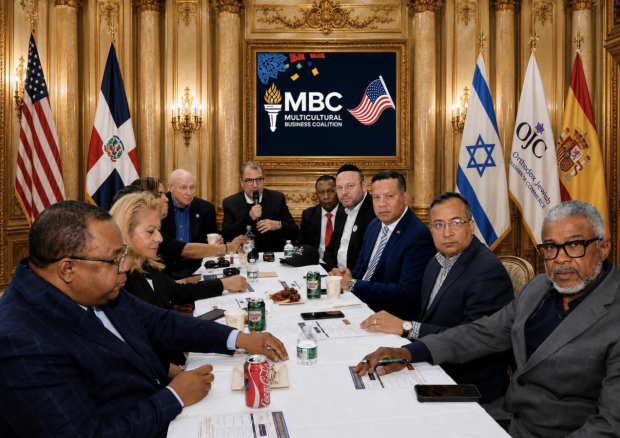
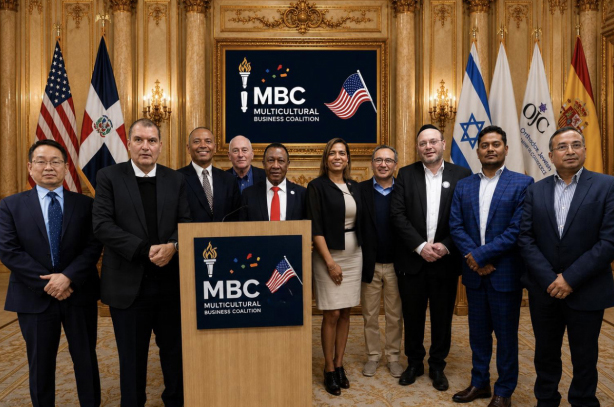
A major new alliance of multicultural business organizations and chambers of commerce has officially been launched in the United States, bringing together nearly 65 ethnic, immigrant, minority, and faith-based business groups under a single national platform.
The newly established Multicultural Business Coalition (MBC) was formally unveiled this week by business leaders representing a broad network of chambers of commerce and advocacy organizations from across the country. Organizers describe the coalition as one of the largest coordinated alliances of multicultural business leadership groups formed in recent years.
The coalition unites chambers representing millions of entrepreneurs, small businesses, workers, and consumers from Hispanic, Asian, African, Caribbean, Middle Eastern, Jewish, South Asian, and other immigrant communities. Leaders said the initiative is designed to strengthen collaboration among chambers of commerce that have historically operated independently despite facing many of the same economic and policy challenges.
“Everyone realized we were stronger together than fragmented apart,” said newly elected Chairman Frank Garcia. “Individually, these chambers had influence within their own communities, but collectively we represent enormous economic power and civic influence.”
Following a formal leadership vote, Garcia was elected Chairman, while Kenney Roden was named President of the coalition. Duvi Honig, Co-Founder and CEO of the Orthodox Jewish Chamber of Commerce, was elected Secretary and named Co-Founder of the MBC.
Other leadership appointments included Yenisei Bell as Second Vice Chair, Mark Jaffe overseeing legal affairs, James Kim leading international relations, Jairo Guzman coordinating Mexican-American chamber outreach, Manuel Lebrón serving on the board, and Porras Zambrano, UN Global Peace Ambassador 2026, joining the coalition leadership team.
Coalition leaders said the MBC aims to serve not only as a networking platform for chambers of commerce, but also as a coordinated national advocacy force capable of engaging government agencies, policymakers, and major corporations with greater influence.
The organization plans to focus on economic empowerment, supplier diversity, workforce inclusion, public policy advocacy, international trade opportunities, and combating discrimination affecting multicultural and immigrant-owned businesses.
“Today we represent tens of millions of voices,” Honig said. “This coalition gives us the ability to engage government, shape policy discussions, and ensure every community is heard and protected.”
Leaders also emphasized that the coalition reflects a broader national shift as multicultural communities increasingly recognize their combined business and voting power.
“This coalition represents an unprecedented alliance of business and civic leadership,” said Mark Jaffe of the Greater New York Chamber of Commerce. “Bringing these chambers together creates scale, coordination, and a much stronger voice when dealing with government and major institutions.”
President Kenney Roden said the coalition is focused on turning unity into coordinated national action.
“Our communities contribute enormously to the American economy,” Roden said. “This coalition gives chambers of commerce the structure to organize strategically, advocate collectively, and engage nationally in ways that simply did not exist before.”
Coalition leaders also highlighted the growing international influence of immigrant and diaspora business networks connected to Latin America, Asia, the Caribbean, and Europe.
“The economic reach of these communities extends globally,” said James Kim, who will oversee international relations for the coalition. “Together we can strengthen international business partnerships, trade relationships, and investment opportunities while supporting economic growth in the United States.”
Speaking at the launch event, Porras Zambrano described the coalition as a symbol of unity, peace, and economic cooperation among diverse communities.
Organizations represented at the launch included the Asian American Women’s Chamber of Commerce, Bangladeshi American Chamber of Commerce, Bronx Hispanic Chamber of Commerce, Caribbean American Chamber of Commerce and Industry, Greater New York Chamber of Commerce, Korean American Chamber of Commerce USA, Mexican American Chamber of Commerce of Texas, Orthodox Jewish Chamber of Commerce, Peruvian Chamber of Commerce USA, United States Bangladesh Chamber of Commerce and Industry (USBCCI), and several other chambers of commerce and business associations nationwide.
Organizers said additional chambers of commerce are expected to formally join the coalition in the coming months as the organization expands its national presence.
The coalition’s next phase will include national policy forums, trade initiatives, economic summits, and direct engagement with federal, state, and local governments.
“This is only the beginning,” Honig said. “When we stand together, our voice carries real weight.”